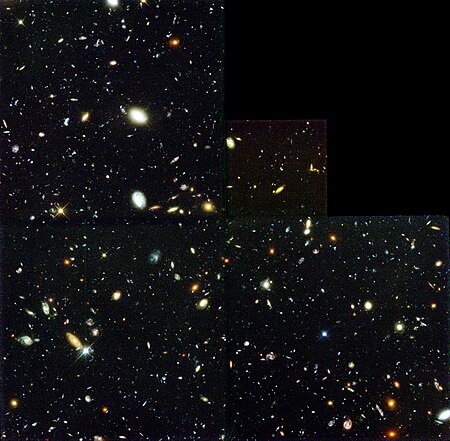
We started today’s meeting by exploring the Hubble Deep Field project which started in 1995 when NASA decided to point the telescope at a dark part of the sky for ten consecutive days between December 18 to 28, 1995 after corrective optics had been installed.
The final combined image produced was assembled from 342 separate exposures and revealed a plethora of distant, faint galaxies.
We then moved on to consider the Parker Solar Probe, one of a fleet of satellite observatories continuously observing our Sun. The Parker Solar Probe is a NASA space probe launched in 2018 to make observations of the Sun's outer corona. It used repeated gravity assists from Venus to develop an eccentric orbit, approaching within 9.86 solar radii from the centre of the Sun.
This took us on to considering how gravity assists work on planning for such events using celestial mechanics to plan the mission. These have been developed over centuries since the Greek astronomer Ptolemy proposed a system of planetary motion which was added to later by Nickolaus Copernicus, Tyco Brahe’s observations, Kepler laws describing planetary motion and Newtons laws of motion.